Publications

2026

Journal
  • Thumbnail for publication Wachowiak_THRI2026.

    What Questions Should Robots Be Able to Answer? A Dataset of User Questions for Explainable Robotics
    Lennart Wachowiak, Andrew Coles, Gerard Canal, and Oya Celiktutan
    ACM Transactions on Human-Robot Interaction (THRI), 2026

    Abstract:
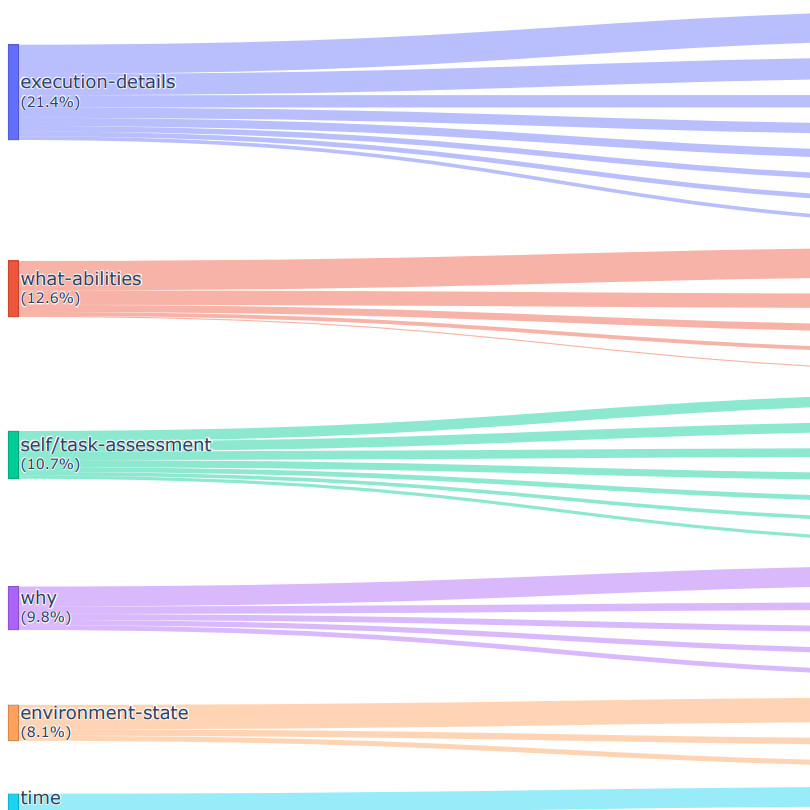
    With the growing use of large language models and conversational interfaces in human-robot interaction, robots’ ability to answer user questions is more important than ever. We therefore introduce a dataset of 1,893 user questions for household robots, collected from 100 participants and organized into 12 categories and 70 subcategories. Most work in explainable robotics focuses on why-questions, such as “Why did you clean the bathroom but not the kitchen?” In contrast, our dataset provides a wide variety of questions, from questions about simple execution details to questions about how the robot would act in hypothetical scenarios — thus giving roboticists valuable insights into what questions their robot needs to be able to answer. To collect the dataset, we created 15 video stimuli and 7 text stimuli, depicting robots performing varied household tasks. We then asked participants on Prolific what questions they would want to ask the robot in each portrayed situation. In the final dataset, the most frequent categories are questions about task execution details (21.4%), the robot’s capabilities (12.6%), and performance assessments (10.7%). Although questions about how robots would handle potentially difficult scenarios and ensure correct behavior are less frequent, users rank them as the most important for robots to be able to answer.
    Moreover, we find that users who identify as novices in robotics ask different questions than more experienced users. Novices are more likely to inquire about simple facts, such as what the robot did or the current state of the environment. As robots enter environments shared with humans and language becomes central to giving instructions and interaction, this dataset provides a valuable foundation for (i) identifying the information robots need to log and expose to conversational interfaces, (ii) benchmarking question-answering modules, and (iii) designing explanation strategies that align with user expectations.
    @article{Wachowiak_THRI2026,
    author = "Lennart Wachowiak and Andrew Coles and Gerard Canal and Oya Celiktutan",
    title = "{What Questions Should Robots Be Able to Answer? A Dataset of User Questions for Explainable Robotics}",
    journal = "ACM Transactions on Human-Robot Interaction (THRI)",
    year = "2026",
    doi = "10.1145/3832777"
    }
  • Thumbnail for publication Olivares-Alarcos_IS2026.

    Ontological foundations for contrastive explanatory narration of robot plans
    Alberto Olivares-Alarcos, Sergi Foix, Júlia Borràs, Gerard Canal, and Guillem Alenyà
    Information Sciences, 741: 123280, 2026

    Abstract:
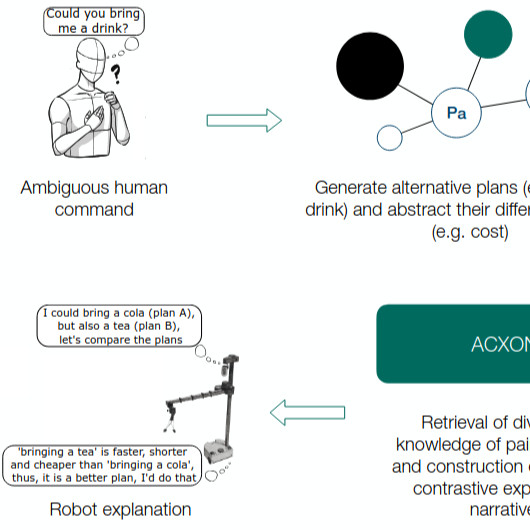
    Mutual understanding of artificial agents’ decisions is key to ensuring a trustworthy and successful human-robot interaction. Hence, robots are expected to make reasonable decisions and communicate them to humans when needed. In this article, the focus is on an approach to modeling and reasoning about the comparison of two competing plans, so that robots can later explain the divergent result. First, a novel ontological model is proposed to formalize and reason about the differences between competing plans, enabling the classification of the most appropriate one (e.g., the shortest, the safest, the closest to human preferences, etc.). This work also investigates the limitations of a baseline algorithm for ontology-based explanatory narration. To address these limitations, a novel algorithm is presented, leveraging divergent knowledge between plans and facilitating the construction of contrastive narratives. Through empirical evaluation, it is observed that the explanations excel beyond the baseline method.
    @article{Olivares-Alarcos_IS2026,
    author = "Alberto Olivares-Alarcos and Sergi Foix and Júlia Borràs and Gerard Canal and Guillem Alenyà",
    title = "{Ontological foundations for contrastive explanatory narration of robot plans}",
    journal = "Information Sciences",
    volume = "741",
    pages = "123280",
    year = "2026",
    issn = "0020-0255",
    url = "https://www.sciencedirect.com/science/article/pii/S0020025526002112",
    doi = "10.1016/j.ins.2026.123280"
    }
Conference Proceedings
  • Thumbnail for publication Armony_iswc2026.

    TP-ONT: An Ontology for Enhanced Reasoning in AI Task Planning via Atomic Decomposition
    Ma’ayan Armony, Albert Meroño-Peñuela, and Gerard Canal
    The Semantic Web – ISWC 2026, 2026

    Abstract:
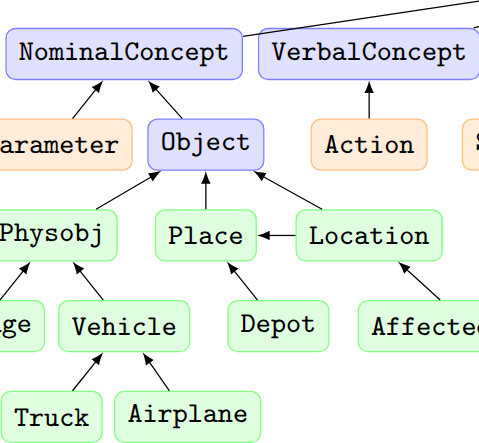
    AI planning involves finding a sequence of actions that achieve a predefined goal when executed from a given initial state of the environment. Task planning is used to execute tasks specified in formal planning description languages. Ontologies to support the planning process have mainly been used in robotics; however, existing ontologies rarely provide direct mappings between planning constructs and semantic representations, and they typically do not decompose planning terms into their constituent elements. This limits expressive querying, task analysis across environments, and the integration of external knowledge. In this paper, we present TP-ONT, a novel ontology for task planning designed to address these shortcomings. TP-ONT decomposes states and predicates into their atomic components and incorporates object type hierarchies, enabling richer reasoning over relations between specified environments, actions, states, and plans. Our framework for knowledge graph and ontology construction allows automatic extension from new planning descriptions, as well as new plan solutions. Evaluation using 18 competency questions shows that the baseline ontologies can answer at most 7 questions partially or fully, whereas TP-ONT is able to answer all questions.
    @inproceedings{Armony_iswc2026,
    author = "Ma'ayan Armony and Albert Meroño-Peñuela and Gerard Canal",
    title = "{TP-ONT: An Ontology for Enhanced Reasoning in AI Task Planning via Atomic Decomposition}",
    booktitle = "The Semantic Web -- ISWC 2026",
    year = "2026",
    publisher = "Springer Nature Switzerland"
    }
  • Thumbnail for publication Gowa_taros2026.

    Integrating Reachability Analysis with Task Planning for Proactive Human-Robot Collaboration
    Vernell Gowa, Peter Tisnikar, and Gerard Canal
    Towards Autonomous Robotic Systems (TAROS), 2026

    Abstract:
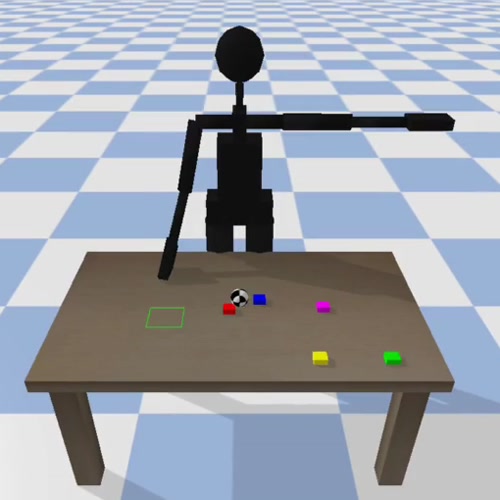
    Planning for human-robot collaboration is difficult when the planner has incomplete knowledge of the human partner’s capabilities, and it often results in infeasible task plans, requiring extensive replanning. In this paper, we propose to frame this difficulty as a domain knowledge completion problem and augment a collaborative PDDL planner with a learned classifier that predicts the partner’s ability to reach objects.
    We show that a learned reachability classifier can approximate the reaching abilities of a simulated human partner. Then, we show that in a collaborative block-stacking domain, capability awareness improves first-plan success rates and reduces plan failures compared to purely reactive and heuristic baselines.
    @inproceedings{Gowa_taros2026,
    author = "Vernell Gowa and Peter Tisnikar and Gerard Canal",
    title = "{Integrating Reachability Analysis with Task Planning for Proactive Human-Robot Collaboration}",
    booktitle = "Towards Autonomous Robotic Systems (TAROS)",
    publisher = "Springer International Publishing",
    year = "2026"
    }
  • Thumbnail for publication wachowiak_hrilbr26.

    Neurosymbolic Explanation Selection in Robotics: Combining the Strengths of Planning and Foundation Models for XAI
    Lennart Wachowiak, Andrew Coles, Oya Celiktutan, and Gerard Canal
    Companion Proceedings of the 21st ACM/IEEE International Conference on Human-Robot Interaction, pp. 222–227, 2026

    Abstract:
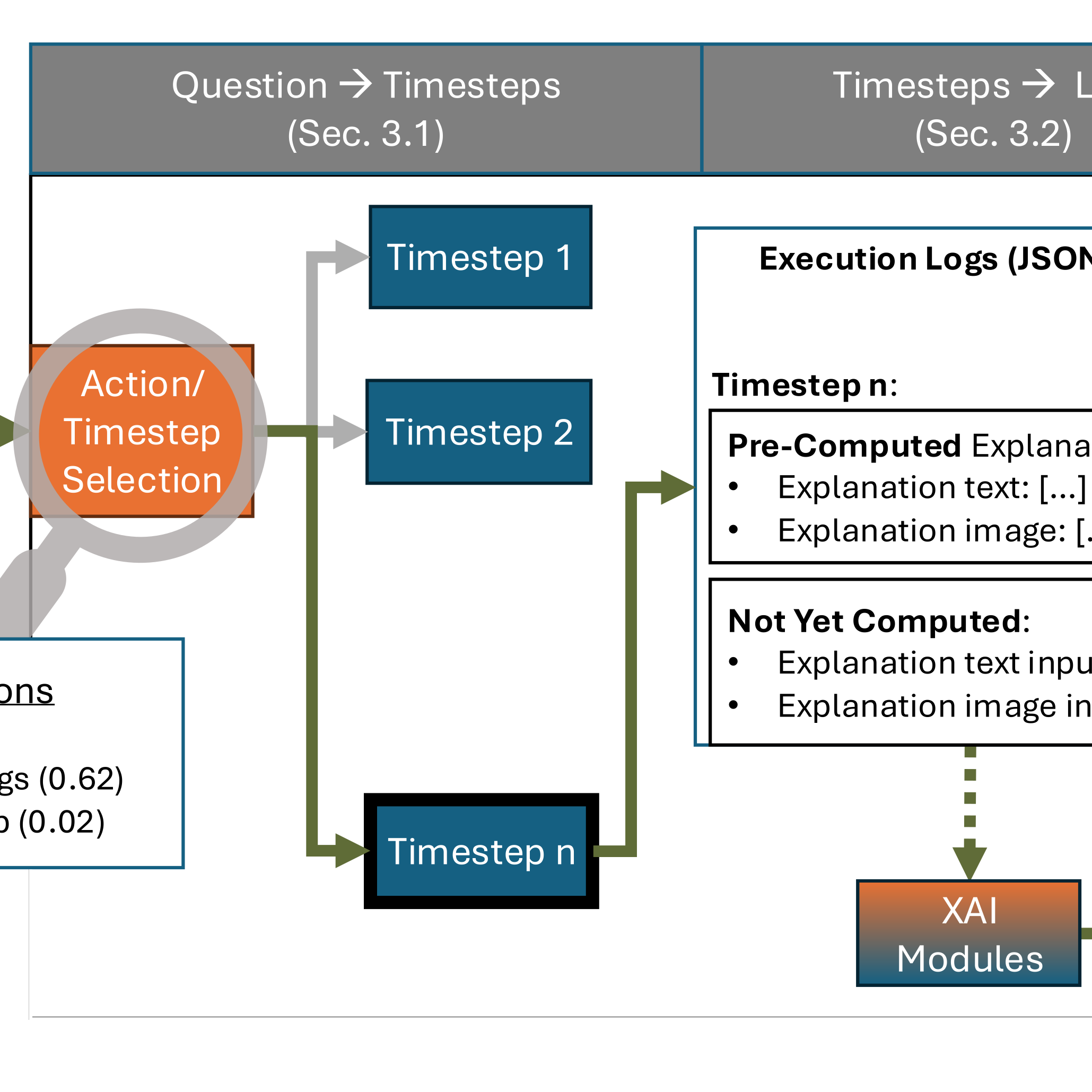
    Robots operating in human environments should be able to answer diverse, explanation-seeking questions about their past behavior. We present a neurosymbolic pipeline that links a task planner with a unified logging interface, which attaches heterogeneous XAI artifacts (e.g., visual heatmaps, navigation feedback) to individual plan steps. Given a natural language question, a large language model selects the most relevant actions and consolidates the associated logs into a multimodal explanation. In an offline evaluation on 180 questions across six plans in two domains, we show that an LLM-based question matcher retrieves relevant plan steps accurately (F1 Score of 0.91), outperforming a lower-compute embedding baseline (0.62) and a rule-based syntax/keyword matcher (0.02). A preliminary user study (N=30) suggests that users prefer the LLM-consolidated explanations over raw logs and planner-only explanations.
    @inproceedings{wachowiak_hrilbr26,
    author = "Lennart Wachowiak and Andrew Coles and Oya Celiktutan and Gerard Canal",
    title = "{Neurosymbolic Explanation Selection in Robotics: Combining the Strengths of Planning and Foundation Models for XAI}",
    booktitle = "Companion Proceedings of the 21st ACM/IEEE International Conference on Human-Robot Interaction",
    pages = "222–227",
    year = "2026",
    publisher = "Association for Computing Machinery",
    location = "Edinburgh, Scotland, UK",
    series = "HRI Companion '26",
    doi = "10.1145/3776734.3794387"
    }
Conference Workshop
  • Thumbnail for publication Armony_keps2026.

    When Can Planning Benefit from Common-Sense Knowledge?
    Ma’ayan Armony, Albert Meroño-Peñuela, and Gerard Canal
    ICAPS Workshop on Knowledge Engineering for Planning and Scheduling (KEPS), 2026

    Abstract:
    To improve the quality of plans and ensure their alignment with the real-world environment, existing works have explored the integration of external knowledge with AI planning.
    Most of these approaches are motivated with examples from real-world scenarios and evaluated on a subset of domains, with a focus on household environments. The collective choice of certain tasks for evaluation suggests that some tasks can further benefit from external knowledge than others. However, the choice of environment in integration methods is rarely rationalised or justified, and the generalisability of approaches across domains is not often discussed.
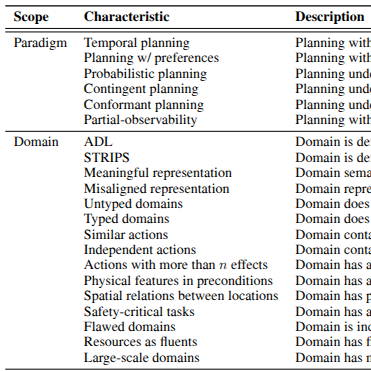
    In this paper, we examine the characteristics that influence when planning tasks benefit from integrating external knowledge, such as semantic and common-sense knowledge, into decision-making within AI planning. We provide a systematic classification of these characteristics according to their scope (spanning the task, domain, problem, and plan) and relate them to the specific stages of the planning process in which they play a role - the task description, the search process, post-planning analysis, and plan execution.
    @inproceedings{Armony_keps2026,
    author = "Ma'ayan Armony and Albert Meroño-Peñuela and Gerard Canal",
    title = "{When Can Planning Benefit from Common-Sense Knowledge?}",
    booktitle = "ICAPS Workshop on Knowledge Engineering for Planning and Scheduling (KEPS)",
    year = "2026"
    }
There are no PhD theses in 2026.
There are no book chapters in 2026.

2025

Journal
  • Thumbnail for publication Wachowiak_TAC2024.

    Predicting When and What to Explain from Multimodal Eye Tracking and Task Signals
    Lennart Wachowiak, Peter Tisnikar, Gerard Canal, Andrew Coles, Matteo Leonetti, and Oya Celiktutan
    IEEE Transactions on Affective Computing, 16(1): 179-190, 2025
    Published online in 2024

    Abstract:
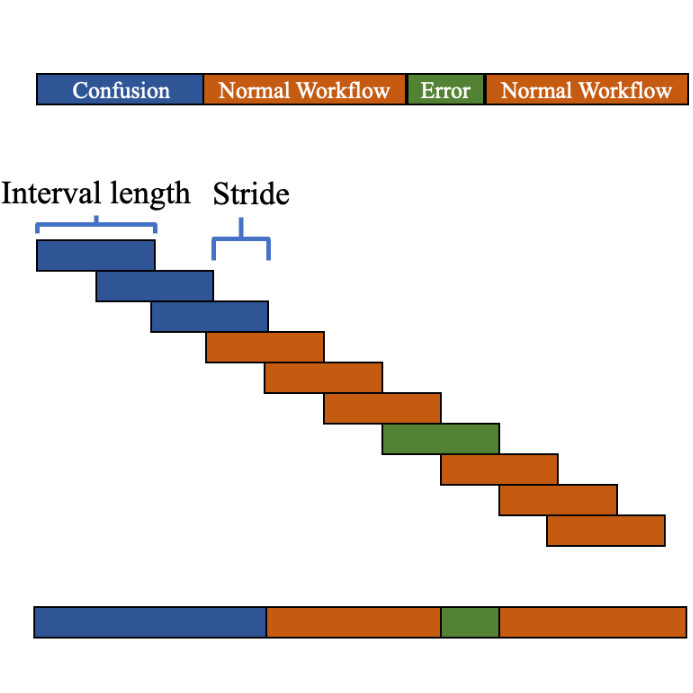
    While interest in the field of explainable agents increases, it is still an open problem to incorporate a proactive explanation component into a real-time human-agent collaboration. Thus, when collaborating with a human, we want to enable an agent to identify critical moments requiring timely explanations. We differentiate between situations requiring explanations about the agent’s decision-making and assistive explanations supporting the user. In order to detect these situations, we analyze the eye-tracking signals of participants engaging in a collaborative virtual cooking scenario. Firstly, we show how users’ gaze patterns differ between moments of user confusion, the agent making errors, and the user successfully collaborating with the agent. Secondly, we evaluate different state-of-the-art models on the task of predicting whether the user is confused or the agent makes errors using gaze- and task-related data. An ensemble of MiniRocket classifiers performs best, especially when updating its predictions with high frequency based on input samples capturing time windows of 3 to 5 seconds. We find that gaze is a significant predictor of when and what to explain. Gaze features are crucial to our classifier’s accuracy, with task-related features benefiting the classifier to a smaller extent.
    @article{Wachowiak_TAC2024,
    author = "Lennart Wachowiak and Peter Tisnikar and Gerard Canal and Andrew Coles and Matteo Leonetti and Oya Celiktutan",
    title = "{Predicting When and What to Explain from Multimodal Eye Tracking and Task Signals}",
    journal = "IEEE Transactions on Affective Computing",
    year = "2025",
    volume = "16",
    number = "1",
    pages = "179-190",
    doi = "10.1109/TAFFC.2024.3419696"
    }
There are no conference proceedings papers in 2025.
Conference Workshop
  • Thumbnail for publication Evans_hriws2025.

    Towards Inclusive Robot Competitions
    Zoe Evans, Muhammad Abdul Basit Malik, Matteo Leonetti, Gerard Canal, and Martim Brandao
    4th Diversity, Equity, & Inclusion in HRI Workshop at HRI'25, 2025

    Abstract:
    Robot competitions such as RoboCup have long been a way promote and evaluate progress in robotics research. Since competitions have the potential to shape the direction of research, it is vital that they are inclusive of the people they will affect and critical of the practices and technologies they advocate for. This work aims to understand what gaps there are in robot competitions in regards to fostering inclusive development practices.
    In particular, we examine technical development reports from the 2024 Eindhoven RoboCup@Home league, and we find that many teams do not report on fairness or inclusivity practices, some sub-task specifications are inherently problematic, and that relevant stakeholders are not involved in the design or evaluation of the competition. We offer recommendations to improve inclusivity in the RoboCup@Home league, which in turn could positively influence other areas of robotics development.
    @inproceedings{Evans_hriws2025,
    author = "Zoe Evans and Muhammad Abdul Basit Malik and Matteo Leonetti and Gerard Canal and Martim Brandao",
    title = "{Towards Inclusive Robot Competitions}",
    booktitle = "4th Diversity, Equity, \& Inclusion in HRI Workshop at HRI'25",
    year = "2025"
    }
There are no PhD theses in 2025.
There are no book chapters in 2025.

2024

Journal
  • Thumbnail for publication Wachowiak_IJSR2024.

    A Taxonomy of Explanation Types and Need Indicators in Human–Agent Collaborations
    Lennart Wachowiak, Andrew Coles, Gerard Canal, and Oya Celiktutan
    International Journal of Social Robotics, 16(7): 1681–1692, 2024

    Abstract:
    In recent years, explanations have become a pressing matter in AI research. This development was caused by the increased use of black-box models and a realization of the importance of trustworthy AI. In particular, explanations are necessary for human-agent interactions to ensure that the user can trust the agent and that collaborations are effective.
    Human-agent interactions are complex social scenarios involving a user, an autonomous agent, and an environment or task with its own distinct properties. Thus, such interactions require a wide variety of explanations, which are not covered by the methods of a single AI discipline, such as computer vision or natural language processing. In this paper, we map out what types of explanations are important for human-agent interactions, surveying the field via a scoping review. In addition to the typical introspective explanation tackled by explainability researchers, we look at assistive explanations, aiming to support the user with their task. Secondly, we survey what causes the need for an explanation in the first place. We identify a variety of human-agent interaction-specific causes and categorize them by whether they are centered on the agent’s behavior, the user’s mental state, or an external entity. Our overview aims to guide robotics practitioners in designing agents with more comprehensive explanation-related capacities, considering different explanation types and the concrete times when explanations should be given.
    @article{Wachowiak_IJSR2024,
    author = "Lennart Wachowiak and Andrew Coles and Gerard Canal and Oya Celiktutan",
    title = "{A Taxonomy of Explanation Types and Need Indicators in Human–Agent Collaborations}",
    journal = "{International Journal of Social Robotics}",
    year = "2024",
    issn = "1875-4805",
    doi = "10.1007/s12369-024-01148-8",
    publisher = "Springer",
    pages = "1681–1692",
    volume = "16",
    number = "7"
    }
Conference Proceedings
  • Thumbnail for publication Wachowiak_icmi2024.

    A Time Series Classification Pipeline for Detecting Interaction Ruptures in HRI Based on User Reactions
    Lennart Wachowiak, Peter Tisnikar, Andrew Coles, Gerard Canal, and Oya Celiktutan
    Proceedings of the 26th International Conference on Multimodal Interaction (ICMI ‘24), pp. 657-665, 2024

    Abstract:
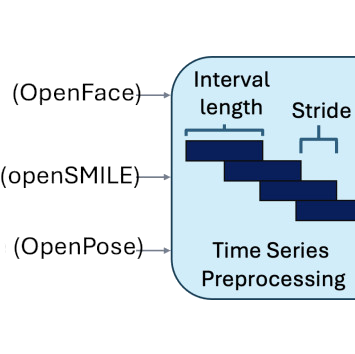
    To be able to react to interaction ruptures such as errors, a robot needs a way of realizing such a rupture occurred. We test whether it is possible to detect interaction ruptures from the user’s anonymized speech, posture, and facial features. We showcase how to approach this task, presenting a time series classification pipeline that works well with various machine learning models. A sliding window is applied to the data and the continuously updated predictions make it suitable for detecting ruptures in real-time. Our best model, an ensemble of MiniRocket classifiers, is the winning approach to the ICMI ERR@HRI challenge. A feature importance analysis shows that the model heavily relies on speaker diarization data that indicates who spoke when. Posture data, on the other hand, impedes performance. Our code is available online.
    @inproceedings{Wachowiak_icmi2024,
    author = "Lennart Wachowiak and Peter Tisnikar and Andrew Coles and Gerard Canal and Oya Celiktutan",
    title = "{A Time Series Classification Pipeline for Detecting Interaction Ruptures in HRI Based on User Reactions}",
    year = "2024",
    month = "Nov",
    pages = "657-665",
    booktitle = "Proceedings of the 26th International Conference on Multimodal Interaction (ICMI '24)",
    isbn = "9798400704628",
    publisher = "Association for Computing Machinery",
    doi = "10.1145/3678957.3688386"
    }
  • Thumbnail for publication Izquierdo-Badiola_ecai2024.

    Planning for Human-Robot Collaboration Scenarios with Heterogeneous Costs and Durations
    Silvia Izquierdo-Badiola, Gerard Canal, Guillem Alenyà, Carlos Rizzo, and Andrew Coles
    ECAI 2024, pp. 4410-4417, 2024

    Abstract:
    This paper looks at human-robot collaboration (HRC) scenarios, in particular where the durations and costs of the actions are heterogeneous between agents, reflecting the agents’ capabilities as well as environmental constraints. We explore the use of temporal PDDL planning as a means of finding over-arching task plans for such collaborative scenarios, and apply suitable heuristics and search algorithms to improve the extent to which plans can be found that are sensitive to combined duration and cost metrics. An evaluation in a kitchen scenario shows our approach is effective, finding cost-effective task plans compared to those from existing planners, and a hand-crafted baseline.
    @inproceedings{Izquierdo-Badiola_ecai2024,
    author = "Silvia Izquierdo-Badiola and Gerard Canal and Guillem Alenyà and Carlos Rizzo and Andrew Coles",
    title = "{Planning for Human-Robot Collaboration Scenarios with Heterogeneous Costs and Durations}",
    booktitle = "ECAI 2024",
    year = "2024",
    month = "10",
    doi = "10.3233/FAIA241019",
    pages = "4410-4417"
    }
  • Thumbnail for publication Wachowiak_iros2024.

    Are Large Language Models Aligned with People’s Social Intuitions for Human-Robot Interactions?
    Lennart Wachowiak, Andrew Coles, Oya Celiktutan, and Gerard Canal
    2024 IEEE/RSJ International Conference on Intelligent Robots and Systems (IROS), pp. 2520-2527, 2024

    Abstract:
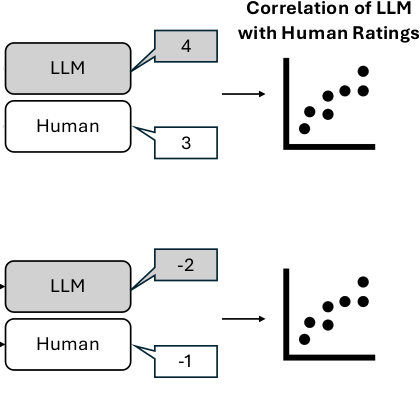
    Large language models (LLMs) are increasingly used in robotics, especially for high-level action planning. Meanwhile, many robotics applications involve human supervisors or collaborators. Hence, it is crucial for LLMs to generate socially acceptable actions that align with people’s preferences and values. In this work, we test whether LLMs capture people’s intuitions about behavior judgments and communication preferences in human–robot interaction (HRI) scenarios. For evaluation, we reproduce three HRI user studies, comparing the output of LLMs with that of real participants. We find that GPT-4 strongly outperforms other models, generating answers that correlate strongly with users’ answers in two studies — the first study dealing with selecting the most appropriate communicative act for a robot in various situations ($r_s$ = 0.82), and the second with judging the desirability, intentionality, and surprisingness of behavior ($r_s$ = 0.83). However, for the last study, testing whether people judge the behavior of robots and humans differently, no model achieves strong correlations. Moreover, we show that vision models fail to capture the essence of video stimuli and that LLMs tend to rate different communicative acts and behavior desirability higher than people.
    @inproceedings{Wachowiak_iros2024,
    author = "Lennart Wachowiak and Andrew Coles and Oya Celiktutan and Gerard Canal",
    title = "{Are Large Language Models Aligned with People's Social Intuitions for Human-Robot Interactions?}",
    booktitle = "2024 IEEE/RSJ International Conference on Intelligent Robots and Systems (IROS)",
    year = "2024",
    month = "10",
    doi = "10.1109/IROS58592.2024.10801325",
    pages = "2520-2527"
    }
  • Thumbnail for publication Tisnikar_iros2024.

    Probabilistic Inference of Human Capabilities from Passive Observations
    Peter Tisnikar, Gerard Canal, and Matteo Leonetti
    2024 IEEE/RSJ International Conference on Intelligent Robots and Systems (IROS), pp. 8779-8785, 2024

    Abstract:
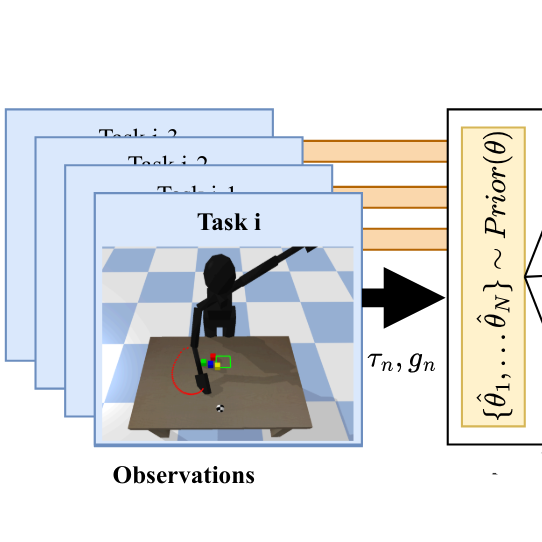
    Modern robots need to adapt to diverse human partners with whom they collaborate. To this end, learning a representation of human capabilities enables the robot to personalize its behaviour to its collaborators across multiple tasks. We propose CApability Modeling from Observations (CAMO), a model-based estimation algorithm, in which human capabilities that parameterize a given model are inferred from observations of the human behaviour on known collaborative tasks. We apply the method to joint limit learning in order to predict future trajectories of a 7-DOF manipulator arm. Furthermore, we show that CAMO can be used as a sub-task assignment routine in a simulated human–robot collaboration scenario, allowing the robot to adapt its task allocation to perform tasks that the person is not able to do.
    @inproceedings{Tisnikar_iros2024,
    author = "Peter Tisnikar and Gerard Canal and Matteo Leonetti",
    title = "{Probabilistic Inference of Human Capabilities from Passive Observations}",
    booktitle = "2024 IEEE/RSJ International Conference on Intelligent Robots and Systems (IROS)",
    year = "2024",
    month = "10",
    pages = "8779-8785",
    doi = "10.1109/IROS58592.2024.10801640"
    }
  • Thumbnail for publication Izquierdo-Badiola_icra2024.

    PlanCollabNL: Leveraging Large Language Models for Adaptive Plan Generation in Human-Robot Collaboration
    Silvia Izquierdo-Badiola, Gerard Canal, Carlos Rizzo, and Guillem Alenyà
    IEEE International Conference on Robotics and Automation (ICRA), pp. 17344-17350, 2024

    Abstract:
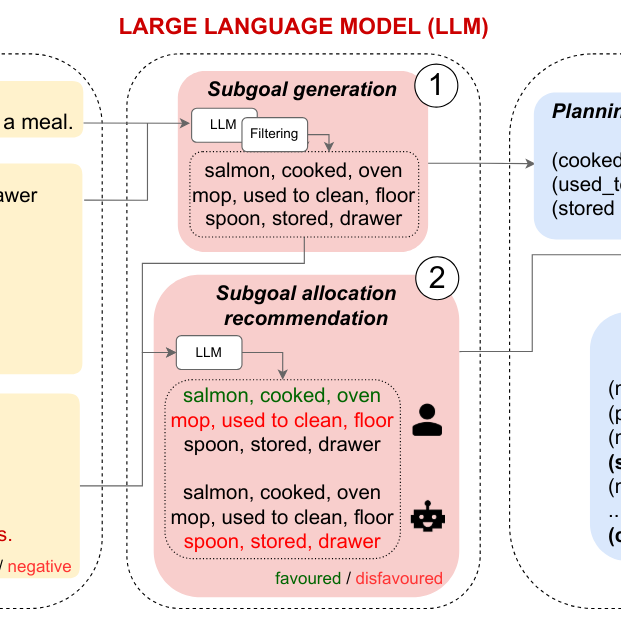
    “Hey, robot. Let’s tidy up the kitchen. By the way, I have back pain today”. How can a robotic system devise a shared plan with an appropriate task allocation from this abstract goal and agent condition? Classical AI task planning has been explored for this purpose, but it involves a tedious definition of an inflexible planning problem. Large Language Models (LLMs) have shown promising generalisation capabilities in robotics decision-making through knowledge extraction from Natural Language (NL). However, the translation of NL information into constrained robotics domains remains a challenge. In this paper, we use LLMs as translators between NL information and a structured AI task planning problem, targeting human-robot collaborative plans. The LLM generates information that is encoded in the planning problem, including specific subgoals derived from an NL abstract goal, as well as recommendations for subgoal allocation based on NL agent conditions. The framework, PlanCollabNL, is evaluated for a number of goals and agent conditions, and the results show that correct and executable plans are found in most cases. With this framework, we intend to add flexibility and generalisation to HRC plan generation, eliminating the need for a manual and laborious definition of restricted planning problems and agent models.
    @inproceedings{Izquierdo-Badiola_icra2024,
    author = "Silvia Izquierdo-Badiola and Gerard Canal and Carlos Rizzo and Guillem Alenyà",
    title = "{PlanCollabNL: Leveraging Large Language Models for Adaptive Plan Generation in Human-Robot Collaboration}",
    booktitle = "IEEE International Conference on Robotics and Automation (ICRA)",
    year = "2024",
    ISSN = "2577-087X",
    month = "5",
    pages = "17344--17350",
    doi = "10.1109/ICRA57147.2024.10610055"
    }
  • Thumbnail for publication Wachowiak_hri2024.

    When Do People Want an Explanation from a Robot?
    Lennart Wachowiak, Andrew Fenn, Haris Kamran, Andrew Coles, Oya Celiktutan, and Gerard Canal
    Proceedings of the 2024 ACM/IEEE International Conference on Human-Robot Interaction, pp. 752–761, 2024

    Abstract:
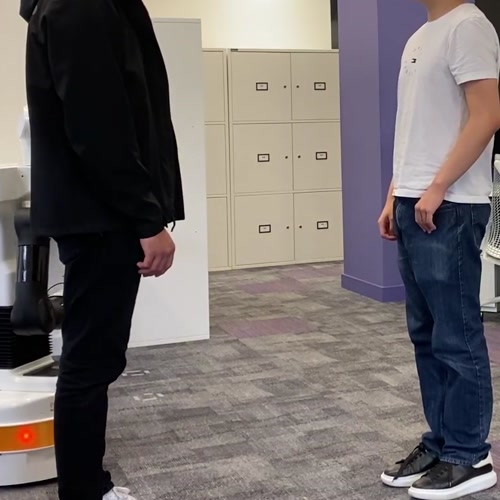
    Explanations are a critical topic in AI and robotics, and their importance in generating trust and allowing for successful human-robot interactions has been widely recognized. However, it is still an open question when and in what interaction contexts users most want an explanation from a robot. In our pre-registered study with 186 participants, we set out to identify a set of scenarios in which users show a strong need for explanations. Participants are shown 16 videos portraying seven distinct situation types, from successful human-robot interactions to robot errors and robot inabilities. Afterwards, they are asked to indicate if and how they wish the robot to communicate subsequent to the interaction in the video. The results provide a set of interactions, grounded in literature and verified empirically, in which people show the need for an explanation. Moreover, we can rank these scenarios by how strongly users think an explanation is necessary and find statistically significant differences. Comparing giving explanations with other possible response types, such as the robot apologizing or asking for help, we find that why-explanations are always among the two highest-rated responses, with the exception of when the robot simply acts normally and successfully. This stands in stark contrast to the other possible response types that are useful in a much more restricted set of situations. Lastly, we test for factors of an individual that might influence their response preferences, for example, their general attitude towards robots, but find no significant correlations. Our results can guide roboticists in designing more user-centered and transparent interactions and let explainability researchers develop more pinpointed explanations.
    @inproceedings{Wachowiak_hri2024,
    author = "Lennart Wachowiak and Andrew Fenn and Haris Kamran and Andrew Coles and Oya Celiktutan and Gerard Canal",
    title = "{When Do People Want an Explanation from a Robot?}",
    year = "2024",
    isbn = "979-8-4007-0322-5",
    publisher = "Association for Computing Machinery",
    address = "New York, NY, USA",
    doi = "10.1145/3610977.3634990",
    booktitle = "Proceedings of the 2024 ACM/IEEE International Conference on Human-Robot Interaction",
    pages = "752–761",
    numpages = "10",
    keywords = "error mitigation, explainability, hri, human-agent interaction, user study, user-centered ai, xai",
    location = "Boulder, CO, USA,",
    series = "HRI '24"
    }
  • Thumbnail for publication Weerawardhana_roman2024.

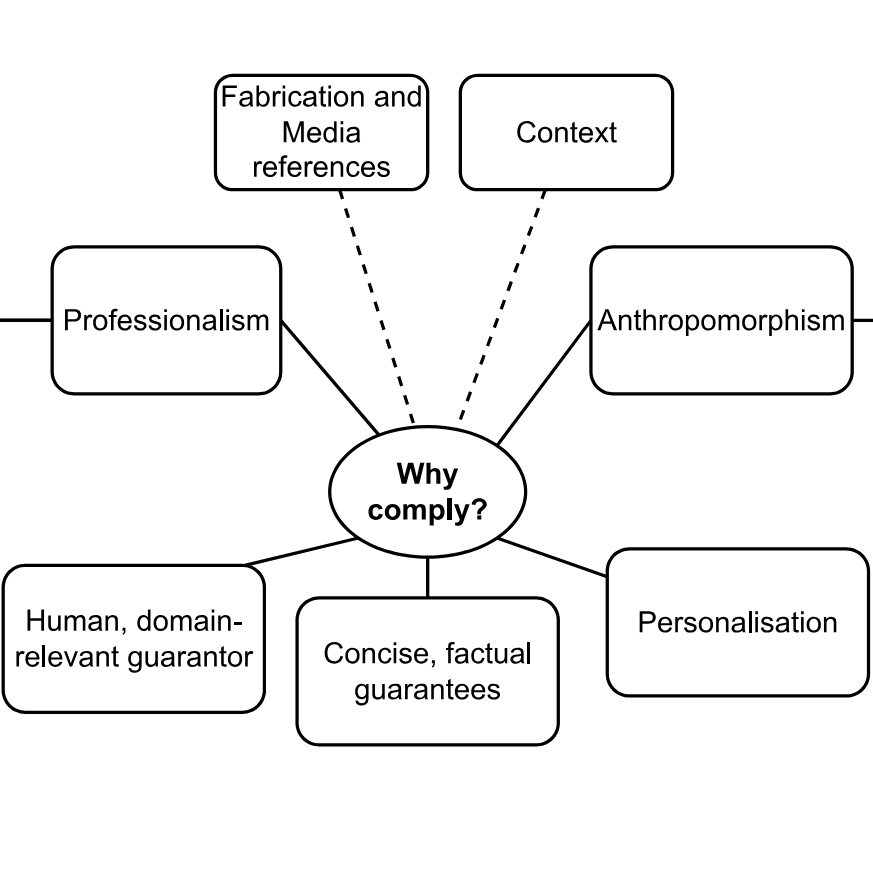
    More Than Trust: Compliance in Instantaneous Human-robot Interactions
    Sachini Weerawardhana, Michael E. Akintunde, Peta Masters, Aaron Roberts, Genovefa Kefalidou, Yang Lu, Gerard Canal, Nicole Lehchevska, Elisabeth Halvorsen, Wei Wei, and Luc Moreau
    IEEE International Symposium on Robot and Human Interactive Communication (RO-MAN), pp. 1556-1563, 2024

    Abstract:
    Compliance is when a human positively responds to a request or a recommendation given by a system. For example, when prompted, providing your thumbprint for an automated biometric scanner at the airport or starting to watch a new TV show on a streaming service ‘we think you will love’. In trust-related research, compliance is frequently used as a behavioural measure of trust. When evaluating the compliance-trust association in experimental settings, typically, the participants agree, when asked, that they complied because they trusted the system. We developed three scenarios in instantaneous settings where compliance with an instruction delivered by a robot would typically be ascribed to trust. However, rather than asking, ‘Did you trust?’, we asked, ‘Why did you comply?’ In a thematic analysis of responses, we discovered robot design characteristics and sources not related to the design that persuade humans to comply with instructions delivered by a robot.
    @inproceedings{Weerawardhana_roman2024,
    author = "Sachini Weerawardhana and Michael E. Akintunde and Peta Masters and Aaron Roberts and Genovefa Kefalidou and Yang Lu and Gerard Canal and Nicole Lehchevska and Elisabeth Halvorsen and Wei Wei and Luc Moreau",
    title = "{More Than Trust: Compliance in Instantaneous Human-robot Interactions}",
    booktitle = "IEEE International Symposium on Robot and Human Interactive Communication (RO-MAN)",
    year = "2024",
    doi = "10.1109/RO-MAN60168.2024.10731378",
    pages = "1556-1563"
    }
  • Thumbnail for publication Olivares-Alarcos_aamas2024.

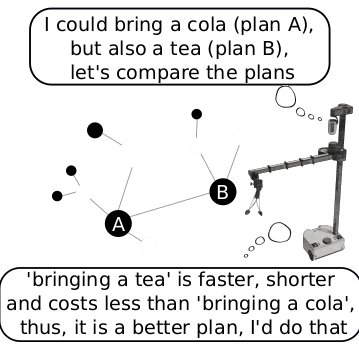
    Ontological modeling and reasoning for comparison and contrastive narration of robot plans
    Alberto Olivares-Alarcos, Sergi Foix, Júlia Borràs, Gerard Canal, and Guillem Alenyà
    Proceedings of the 23rd International Conference on Autonomous Agents and Multiagent Systems (AAMAS), pp. 2405–2407, 2024

    Abstract:
    This extended abstract focuses on an approach to modeling and reasoning about the comparison of competing plans, so that robots can later explain the divergent result. First, the need for a novel ontological model that empowers robots to formalize and reason about plan divergences is identified. Then, a new ontological theory is proposed to facilitate the classification of plans (e.g., the shortest, the safest, the closest to human preferences, etc.). Finally, the limitations of a baseline algorithm for ontology-based explanatory narration are examined, and a novel algorithm is introduced to leverage the divergent knowledge between plans, enabling the construction of contrastive narratives. An empirical evaluation is conducted to assess the quality of the explanations provided by the proposed algorithm, which outperforms the baseline method.
    @inproceedings{Olivares-Alarcos_aamas2024,
    author = "Alberto Olivares-Alarcos and Sergi Foix and J{\'u}lia Borr{\`a}s and Gerard Canal and Guillem Aleny{\`a}",
    title = "{Ontological modeling and reasoning for comparison and contrastive narration of robot plans}",
    year = "2024",
    pages = "2405–2407",
    numpages = "3",
    isbn = "9798400704864",
    publisher = "International Foundation for Autonomous Agents and Multiagent Systems",
    booktitle = "Proceedings of the 23rd International Conference on Autonomous Agents and Multiagent Systems (AAMAS)",
    series = "AAMAS '24",
    url = "https://dl.acm.org/doi/10.5555/3635637.3663175"
    }
Conference Workshop
  • Thumbnail for publication Halilovic_usn2024.

    Towards Probabilistic Planning of Explanations for Robot Navigation
    Amar Halilovic, Senka Krivić, and Gerard Canal
    RSS 2024 Workshop on Unsolved Problems in Social Robot Navigation, 2024

    Abstract:
    In robotics, ensuring that autonomous systems are comprehensible and accountable to users is essential for effective human-robot interaction. This paper introduces a novel approach that integrates user-centered design principles directly into the core of robot path planning processes. We propose a probabilistic framework for automated planning of explanations for robot navigation, where the preferences of different users regarding explanations are probabilistically modeled to tailor the stochasticity of the real-world human-robot interaction and the communication of a robot’s decisions and actions towards humans. This approach aims to enhance the transparency of robot path planning and adapt to diverse user explanation needs by anticipating the types of explanations that will satisfy individual users.
    @inproceedings{Halilovic_usn2024,
    author = "Amar Halilovic and Senka Krivić and Gerard Canal",
    title = "{Towards Probabilistic Planning of Explanations for Robot Navigation}",
    booktitle = "RSS 2024 Workshop on Unsolved Problems in Social Robot Navigation",
    year = "2024"
    }
There are no PhD theses in 2024.
There are no book chapters in 2024.

2023

Journal
  • Thumbnail for publication Canal_UMUAI2022.

    Generating predicate suggestions based on the space of plans: an example of planning with preferences
    Gerard Canal, Carme Torras, and Guillem Alenyà
    User Modeling and User-Adapted Interaction, 33(2): 333–357, 2023
    Published online in 2022

    Abstract:
    Task planning in human–robot environments tends to be particularly complex as it involves additional uncertainty introduced by the human user. Several plans, entailing few or various differences, can be obtained to solve the same given task. To choose among them, the usual least-cost plan criteria is not necessarily the best option, because here, human constraints and preferences come into play. Knowing these user preferences is very valuable to select an appropriate plan, but the preference values are usually hard to obtain. In this context, we propose the Space-of-Plans-based Suggestions (SoPS) algorithms that can provide suggestions for some planning predicates, which are used to define the state of the environment in a task planning problem where actions modify the predicates. We denote these predicates as suggestible predicates, of which user preferences are a particular case. The first algorithm is able to analyze the potential effect of the unknown predicates and provide suggestions to values for these unknown predicates that may produce better plans. The second algorithm is able to suggest changes to already known values that potentially improve the obtained reward. The proposed approach utilizes a Space of Plans Tree structure to represent a subset of the space of plans. The tree is traversed to find the predicates and the values that would most increase the reward, and output them as a suggestion to the user. Our evaluation in three preference-based assistive robotics domains shows how the proposed algorithms can improve task performance by suggesting the most effective predicate values first.
    @article{Canal_UMUAI2022,
    author = "Gerard Canal and Carme Torras and Guillem Alenyà",
    title = "{Generating predicate suggestions based on the space of plans: an example of planning with preferences}",
    journal = "User Modeling and User-Adapted Interaction",
    publisher = "Springer Nature",
    year = "2023",
    number = "2",
    volume = "33",
    pages = "333–357",
    doi = "10.1007/s11257-022-09327-w"
    }
There are no conference proceedings papers in 2023.
Conference Workshop
  • Thumbnail for publication Wachowiak_xro2023.

    A Survey of Evaluation Methods and Metrics for Explanations in Human–Robot Interaction (HRI)
    Lennart Wachowiak, Oya Celiktutan, Andrew Coles, and Gerard Canal
    Explainable Robotics Workshop at IEEE International Conference on Robotics and Automation (ICRA), 2023

    Abstract:
    The crucial role of explanations in making AI safe and trustworthy was not only recognized by the machine learning community but also by roboticists and human–robot interaction researchers. A robot that can explain its actions is supposed to be better perceived by the user, be more reliable, and seem more trustworthy. In collaborative scenarios, explanations are often expected to even improve the team’s performance. To test whether a developed explanation-related ability meets these promises, it is essential to rigorously evaluate them. Due to the many aspects of explanations that can be evaluated, and their varying importance in different circumstances, a plethora of evaluation methods are available. In this survey, we provide a comprehensive overview of such methods while discussing features and considerations unique to explanations given during human–robot interactions.
    @inproceedings{Wachowiak_xro2023,
    author = "Lennart Wachowiak and Oya Celiktutan and Andrew Coles and Gerard Canal",
    title = "{A Survey of Evaluation Methods and Metrics for Explanations in Human–Robot Interaction (HRI)}",
    year = "2023",
    booktitle = "Explainable Robotics Workshop at IEEE International Conference on Robotics and Automation (ICRA)",
    url = "https://openreview.net/forum?id=f2VocjxnCKR"
    }
There are no PhD theses in 2023.
There are no book chapters in 2023.

2022

There are no journal papers in 2022.
Conference Proceedings
  • Thumbnail for publication Wachowiak_roman2022.

    Analysing Eye Gaze Patterns During Confusion and Errors in Human–Agent Collaborations
    Lennart Wachowiak, Peter Tisnikar, Gerard Canal, Andrew Coles, Matteo Leonetti, and Oya Celiktutan
    31st IEEE International Symposium on Robot and Human Interactive Communication (RO-MAN), 2022

    Abstract:
    As human–agent collaborations become more prevalent, it is increasingly important for an agent to be able to adapt to their collaborator and explain their own behavior. In order to do so, they need to be able to identify critical states during the interaction that call for proactive clarifications or behavioral adaptations. In this paper, we explore whether the agent could infer such states from the human’s eye gaze for which we compare gaze patterns across different situations in a collaborative task. Our findings show that the human’s gaze patterns significantly differ between times at which the user is confused about the task, times at which the agent makes an error, and times of normal workflow. During errors the amount of gaze towards the agent increases, while during confusion the amount towards the environment increases. We conclude that these signals could tell the agent what and when to explain.
    @inproceedings{Wachowiak_roman2022,
    author = "Lennart Wachowiak and Peter Tisnikar and Gerard Canal and Andrew Coles and Matteo Leonetti and Oya Celiktutan",
    title = "{Analysing Eye Gaze Patterns During Confusion and Errors in Human–Agent Collaborations}",
    booktitle = "31st IEEE International Symposium on Robot and Human Interactive Communication (RO-MAN)",
    year = "2022",
    doi = "10.1109/RO-MAN53752.2022.9900589"
    }
  • Thumbnail for publication Izquierdo-Badiola_icra2022.

    Improved Task Planning through Failure Anticipation in Human-Robot Collaboration
    Silvia Izquierdo-Badiola, Gerard Canal, Carlos Rizzo, and Guillem Alenyà
    IEEE International Conference on Robotics and Automation (ICRA), pp. 7875-7880, 2022

    Abstract:
    Human-Robot Collaboration (HRC) has become a major trend in robotics in recent years with the idea of combining the strengths from both humans and robots. In order to share the work to be done, many task planning approaches have been implemented. However, they don’t fully satisfy the required adaptability in human-robot collaborative tasks, as plans are often only generated for the robot, who adapts to the human independent activities; with most approaches not considering either the state of the human partner nor the possibility of adapting the collaborative plan during execution. In this paper, we present a planning system for human-robot collaborative plans that takes into account the agents’ states and deals with unforeseen human behaviour, by replanning in anticipation when the human state changes to prevent action failure. The human state is defined in terms of capacity, knowledge and motivation. The system has been implemented in a standardized environment using the Planning Domain Definition Language (PDDL) and the modular ROSPlan framework, and we have validated the approach in multiple simulation settings. Our results show that using the human model fosters an appropriate task allocation while allowing failure anticipation and replanning in time to prevent it.
    @inproceedings{Izquierdo-Badiola_icra2022,
    author = "Silvia Izquierdo-Badiola and Gerard Canal and Carlos Rizzo and Guillem Alenyà",
    title = "{Improved Task Planning through Failure Anticipation in Human-Robot Collaboration}",
    booktitle = "IEEE International Conference on Robotics and Automation (ICRA)",
    year = "2022",
    ISSN = "2577-087X",
    month = "5",
    pages = "7875-7880",
    doi = "10.1109/ICRA46639.2022.9812236"
    }
  • Thumbnail for publication Canal_AAAI2022.

    PlanVerb: Domain-Independent Verbalization and Summary of Task Plans
    Gerard Canal, Senka Krivić, Paul Luff, and Andrew Coles
    Proceedings of the AAAI Conference on Artificial Intelligence, 36(9), pp. 9698-9706, 2022

    Abstract:
    For users to trust planning algorithms, they must be able to understand the planner’s outputs and the reasons for each action selection. This output does not tend to be user-friendly, often consisting of sequences of parametrised actions or task networks. And these may not be practical for non-expert users who may find it easier to read natural language descriptions. In this paper, we propose PlanVerb, a domain and planner-independent method for the verbalization of task plans. It is based on semantic tagging of actions and predicates. Our method can generate natural language descriptions of plans including causal explanations. The verbalized plans can be summarized by compressing the actions that act on the same parameters. We further extend the concept of verbalization space, previously applied to robot navigation, and apply it to planning to generate different kinds of plan descriptions for different user requirements. Our method can deal with PDDL and RDDL domains, provided that they are tagged accordingly. Our user survey evaluation shows that users can read our automatically generated plan descriptions and that the explanations help them answer questions about the plan.
    @inproceedings{Canal_AAAI2022,
    author = "Gerard Canal and Senka Krivić and Paul Luff and Andrew Coles",
    title = "{PlanVerb: Domain-Independent Verbalization and Summary of Task Plans}",
    booktitle = "Proceedings of the AAAI Conference on Artificial Intelligence",
    volume = "36(9)",
    pages = "9698-9706",
    year = "2022",
    month = "6",
    doi = "10.1609/aaai.v36i9.21204"
    }

  • Thumbnail for publication Cantareira_icaps2022.

    Actor-Focused Interactive Visualization for AI Planning
    Gabriel Dias Cantareira, Gerard Canal, and Rita Borgo
    Proceedings of the International Conference on Automated Planning and Scheduling (ICAPS), 32, pp. 678-686, 2022

    Abstract:
    As we grow more reliant on AI systems for an increasing variety of applications in our lives, the need to understand and interpret such systems also becomes more pronounced, be it for improvement, trust, or legal liability. AI Planning is one type of task that provides explanation challenges, particularly due to the increasing complexity in generated plans and convoluted causal chains that connect actions and determine overall plan structure. While there are many recent techniques to support plan explanation, visual aids for navigating this data are quite limited. Furthermore, there is often a barrier between techniques focused on abstract planning concepts and domain-related explanations. In this paper, we present a visual analytics tool to support plan summarization and interaction, focusing in robotics domains using an actor-based structure. We show how users can quickly grasp vital information about actions involved in a plan and how they relate to each other. Finally, we present a framework used to design our tool, highlighting how general PDDL elements can be converted into visual representations and further connecting concept to domain.
    @inproceedings{Cantareira_icaps2022,
    author = "Gabriel Dias Cantareira and Gerard Canal and Rita Borgo",
    title = "{Actor-Focused Interactive Visualization for AI Planning}",
    booktitle = "Proceedings of the International Conference on Automated Planning and Scheduling (ICAPS)",
    volume = "32",
    pages = "678-686",
    year = "2022",
    month = "6",
    doi = "10.1609/icaps.v32i1.19857"
    }
Conference Workshop
  • Thumbnail for publication Bezrucav_intex2022.

    Towards Automatic State Recovery for Replanning
    Stefan-Octavian Bezrucav, Gerard Canal, Andrew Coles, Michael Cashmore, and Burkhard Corves
    ICAPS 2022 Workshop on Integrated Planning, Acting, and Execution (IntEx), 2022

    Abstract:
    Integrated planning and execution on embodied agents necessarily means dealing with execution failures, and it is common to employ on-board replanning to overcome such failures. However, describing the activities of the agent as action definitions appropriate for planning often requires a discrete abstraction of continuous state. As a result, action failure can result in improper planning states that are inconsistent with the ground truth. Attempting to generate a plan in these states can result in planning failure, even in cases where the executive actually has the capability to reach the goal.
    In this paper, we formalize the concept of proper states, the mappings between planning states and underlying execution structures, and lay the grounds towards developing automatic recovery behaviors when execution failures leave the execution in an artificially incorrect planning state.
    @inproceedings{Bezrucav_intex2022,
    author = "Stefan-Octavian Bezrucav and Gerard Canal and Andrew Coles and Michael Cashmore and Burkhard Corves",
    title = "{Towards Automatic State Recovery for Replanning}",
    booktitle = "ICAPS 2022 Workshop on Integrated Planning, Acting, and Execution (IntEx)",
    year = "2022"
    }
  • Thumbnail for publication Tisnikar_parhri2022.

    Towards Autonomous Collaborative Robots that Adapt and Explain
    Peter Tisnikar, Lennart Wachowiak, Gerard Canal, Andrew Coles, Matteo Leonetti, and Oya Celiktutan
    ICRA 2022 Workshop on Prediction and Anticipation Reasoning in Human Robot Interaction, 2022

    Abstract:
    As we will increasingly encounter robots in our everyday lives, engage with them in social interactions, and collaborate on common tasks, it is important we endow them with the capability of adapting to our abilities and preferences. Moreover, we want them to be able to explain the decisions they make in collaborative tasks to maximise rapport and build trust and acceptance. Current explanations are missing a focus on the individual user’s needs, which is why we want to learn when and what to explain in a collaboration. This paper proposes the roadmap that we plan to implement with the goal of inferring the user’s mental state from physiological and social signals in order to inform explanation generation and robot adaptation. We present preliminary results utilizing eye gaze and a planned framework that allows a collaborative robot to adapt to its human collaborator and tailor its explanations to them in order to minimise the confusion in an interaction.
    @inproceedings{Tisnikar_parhri2022,
    author = "Peter Tisnikar and Lennart Wachowiak and Gerard Canal and Andrew Coles and Matteo Leonetti and Oya Celiktutan",
    title = "{Towards Autonomous Collaborative Robots that Adapt and Explain}",
    booktitle = "ICRA 2022 Workshop on Prediction and Anticipation Reasoning in Human Robot Interaction",
    year = "2022"
    }
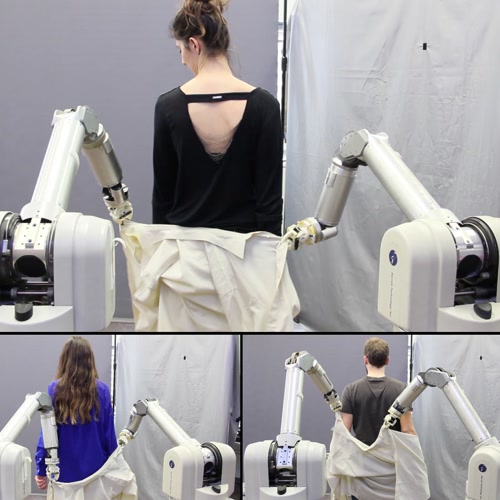
There are no PhD theses in 2022.
There are no book chapters in 2022.

2021

Journal
  • Thumbnail for publication Canal_THRI2021.

    Are Preferences Useful for Better Assistance?: A Physically Assistive Robotics User Study
    Gerard Canal, Carme Torras, and Guillem Alenyà
    ACM Transactions on Human-Robot Interaction (THRI), 10(4): 1-19, 2021

    Abstract:
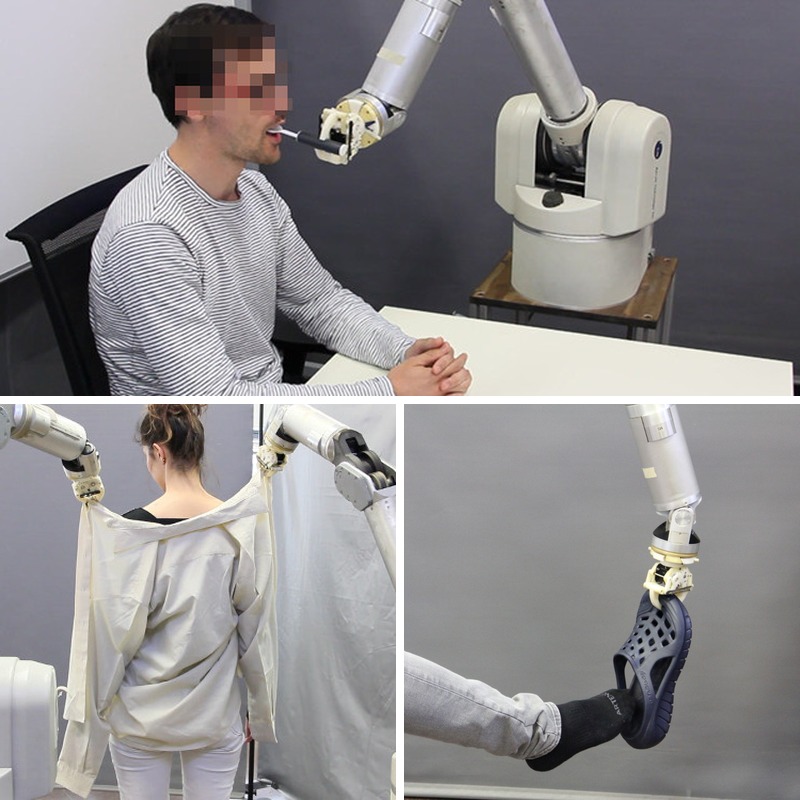
    Assistive Robots have an inherent need of adapting to the user they are assisting. This is crucial for the correct development of the task, user safety, and comfort. However, adaptation can be performed in several manners. We believe user preferences are key to this adaptation. In this paper, we evaluate the use of preferences for Physically Assistive Robotics tasks in a Human-Robot Interaction user evaluation. Three assistive tasks have been implemented consisting of assisted feeding, shoe-fitting, and jacket dressing, where the robot performs each task in a different manner based on user preferences.
    We assess the ability of the users to determine which execution of the task used their chosen preferences (if any). The obtained results show that most of the users were able to successfully guess the cases where their preferences were used even when they had not seen the task before. We also observe that their satisfaction with the task increases when the chosen preferences are employed. Finally, we also analyze the user’s opinions regarding assistive tasks and preferences, showing promising expectations as to the benefits of adapting the robot behavior to the user through preferences.
    @article{Canal_THRI2021,
    author = "Gerard Canal and Carme Torras and Guillem Aleny{\`a}",
    title = "{Are Preferences Useful for Better Assistance?: A Physically Assistive Robotics User Study}",
    journal = "ACM Transactions on Human-Robot Interaction (THRI)",
    year = "2021",
    doi = "10.1145/3472208",
    volume = "10",
    number = "4",
    pages = "1--19",
    articleno = "39"
    }
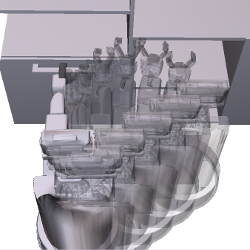
Conference Proceedings
  • Thumbnail for publication Brandao_icra2021.

    Towards providing explanations for robot motion planning
    Martim Brandão, Gerard Canal, Senka Krivić, and Daniele Magazzeni
    IEEE International Conference on Robotics and Automation (ICRA), pp. 3927-3933, 2021

    Abstract:
    Recent research in AI ethics has put forth explainability as an essential principle for AI algorithms. However, it is still unclear how this is to be implemented in practice for specific classes of algorithms—such as motion planners. In this paper we unpack the concept of explanation in the context of motion planning, introducing a new taxonomy of kinds and purposes of explanations in this context. We focus not only on explanations of failure (previously addressed in motion planning literature) but also on contrastive explanations—which explain why a trajectory A was returned by a planner, instead of a different trajectory B expected by the user. We develop two explainable motion planners, one based on optimization, the other on sampling, which are capable of answering failure and constrastive questions. We use simulation experiments and a user study to motivate a technical and social research agenda.
    @inproceedings{Brandao_icra2021,
    author = "Martim Brandão and Gerard Canal and Senka Krivić and Daniele Magazzeni",
    title = "{Towards providing explanations for robot motion planning}",
    booktitle = "IEEE International Conference on Robotics and Automation (ICRA)",
    year = "2021",
    doi = "10.1109/ICRA48506.2021.9562003",
    ISSN = "2577-087X",
    pages = "3927-3933",
    month = "5"
    }
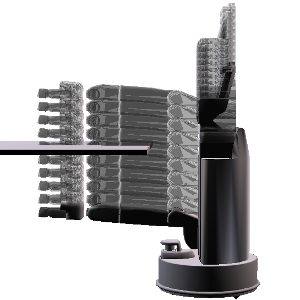
  • Thumbnail for publication Moraru_ukras2021.

    Using Plan Libraries for Improved Plan Execution
    Ionut Moraru, Gerard Canal, and Simon Parsons
    UKRAS21 Conference: “Robotics at home” Proceedings, pp. 51-52, 2021

    Abstract:
    The difficulty of task planning for robotic agents arises from the stochastic nature of their environment and the high cost of a failure during execution meaning frequent replanning is required. One way to address this problem is to make use of a pre-defined plan library. In this paper, we present work that combines a plan library with task planning. Initial results show that such an approach alleviates the computational burden of synthesising plans, while providing the same level of autonomy as using a planner that starts from scratch.
    @inproceedings{Moraru_ukras2021,
    author = "Ionut Moraru and Gerard Canal and Simon Parsons",
    title = "{Using Plan Libraries for Improved Plan Execution}",
    year = "2021",
    booktitle = "UKRAS21 Conference: "Robotics at home" Proceedings",
    pages = "51--52",
    url = "https://uk-ras.org.uk/publications/ukras21-conference-proceedings\#:\textasciitilde :text=INCLUDING\%20HUMAN\%20FACTORS-,USING\%20PLAN\%20LIBRARIES\%20FOR\%20IMPROVED\%20PLAN\%20EXECUTION,-Authors\%3A"
    }
  • Thumbnail for publication Brandao_roman2021.

    How experts explain motion planner output: a preliminary user-study to inform the design of explainable planners
    Martim Brandão, Gerard Canal, Senka Krivić, Paul Luff, and Amanda Coles
    IEEE International Symposium on Robot and Human Interactive Communication (RO-MAN), pp. 299-306, 2021

    Abstract:
    Motion planning is a hard problem that can often overwhelm both users and designers: due to the difficulty in understanding the optimality of a solution, or reasons for a planner to fail to find any solution. Inspired by recent work in machine learning and task planning, in this paper we are guided by a vision of developing motion planners that can provide reasons for their output—thus potentially contributing to better user interfaces, debugging tools, and algorithm trustworthiness. Towards this end, we propose a preliminary taxonomy and a set of important considerations for the design of explainable motion planners, based on the analysis of a comprehensive user study of motion planning experts. We identify the kinds of things that need to be explained by motion planners (“explanation objects”), types of explanation, and several procedures required to arrive at explanations. We also elaborate on a set of qualifications and design considerations that should be taken into account when designing explainable methods. These insights contribute to bringing the vision of explainable motion planners closer to reality, and can serve as a resource for researchers and developers interested in designing such technology.
    @inproceedings{Brandao_roman2021,
    author = "Martim Brandão and Gerard Canal and Senka Krivić and Paul Luff and Amanda Coles",
    title = "{How experts explain motion planner output: a preliminary user-study to inform the design of explainable planners}",
    booktitle = "IEEE International Symposium on Robot and Human Interactive Communication (RO-MAN)",
    year = "2021",
    doi = "10.1109/RO-MAN50785.2021.9515407",
    ISSN = "1944-9437",
    pages = "299-306",
    month = "8"
    }
  • Thumbnail for publication Keren_icaps2021.

    Task-Aware Waypoint Sampling for Robotic Planning
    Sarah Keren, Gerard Canal, and Michael Cashmore
    Proceedings of the International Conference on Automated Planning and Scheduling (ICAPS), 31, pp. 643-651, 2021

    Abstract:
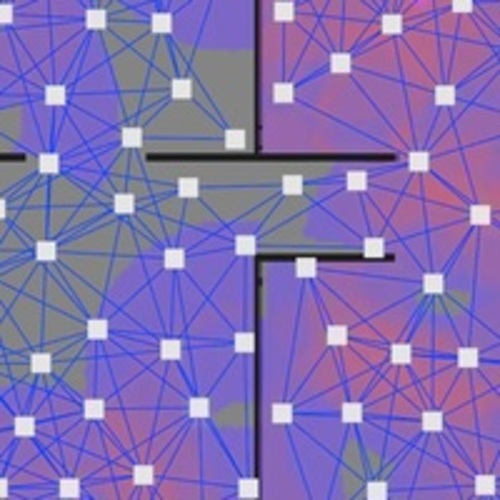
    To achieve a complex task, a robot often needs to navigate in a physical space in order to complete activities in different locations. For example, it may need to inspect several structures, making multiple observations of each structure from different perspectives. Typically, the positions from which these activities can be performed are represented as waypoints – discrete positions that are sampled from the continuous physical space and used to find a task plan. Existing approaches to waypoint selection either iteratively consider the entire space or use domain knowledge to consider each activity separately. This can lead to task planning problems that are more complex than is necessary or to plans of compromised quality. Moreover, all previous approaches only consider geometric constraints that can be imposed on the waypoint selection process. We present Task-Aware Waypoint Sampling (TAWS), which offers two key novelties. First, it is an anytime approach that combines the benefits of random sampling with the use of domain knowledge in waypoint selection by performing a one-time computation of the connectivity graph from which waypoints are sampled. In addition, TAWS is the first approach that accounts for performance preferences, which are preferences a system operator may have about the generated task plan. These can account, for example, for areas near doorways where it is preferable that the robot does not stop to perform activities. We demonstrate the performance benefits of our approach on simulated automated manufacturing tasks.
    @inproceedings{Keren_icaps2021,
    author = "Sarah Keren and Gerard Canal and Michael Cashmore",
    title = "{Task-Aware Waypoint Sampling for Robotic Planning}",
    booktitle = "Proceedings of the International Conference on Automated Planning and Scheduling (ICAPS)",
    volume = "31",
    year = "2021",
    month = "5",
    pages = "643-651",
    doi = "10.1609/icaps.v31i1.16013"
    }
Conference Workshop
  • Thumbnail for publication Canal_xaip2021.

    Task Plan verbalizations with causal justifications
    Gerard Canal, Senka Krivić, Paul Luff, and Andrew Coles
    ICAPS 2021 Workshop on Explainable AI Planning (XAIP), 2021

    Abstract:
    To increase user trust in planning algorithms, users must be able to understand the output of the planner while getting some notion of the underlying reasons for the action selection.
    The output of task planners have not been traditionally user-friendly, often consisting of sequences of parametrised actions or task networks, which may not be practical for lay and non-expert users who may find it easier to read natural language descriptions. In this paper, we propose PlanVerb, a domain and planner-independent method for the verbalization of task plans based on semantic tagging of the actions and predicates. Our method can generate natural language descriptions of plans including explanations of causality between actions. The verbalized plans can be summarized by compressing the actions that act on the same parameters. We further extend the concept of verbalization space, previously applied to robot navigation, and apply it to planning to generate different kinds of plan descriptions depending on the needs or preferences of the user. Our method can deal with PDDL and RDDL domains, provided that they are tagged accordingly. We evaluate our results with a user survey that shows that users can read our automatically generated plan descriptions, and are able to successfully answer questions about the plan.
    We believe methods like the one we propose can be used to foster trust in planning algorithms in a wide range of domains and applications.
    @inproceedings{Canal_xaip2021,
    author = "Gerard Canal and Senka Krivić and Paul Luff and Andrew Coles",
    title = "{Task Plan verbalizations with causal justifications}",
    booktitle = "ICAPS 2021 Workshop on Explainable AI Planning (XAIP)",
    year = "2021",
    url = "https://openreview.net/forum?id=4T9oO\_MrhEm"
    }
  • Thumbnail for publication Bezrucav_planrob2021.

    An Action Interface Manager for ROSPlan
    Stefan-Octavian Bezrucav, Gerard Canal, Michael Cashmore, and Burkhard Corves
    Proceedings of the 9th ICAPS Workshop on Planning and Robotics (PlanRob), pp. 1-9, 2021

    Abstract:
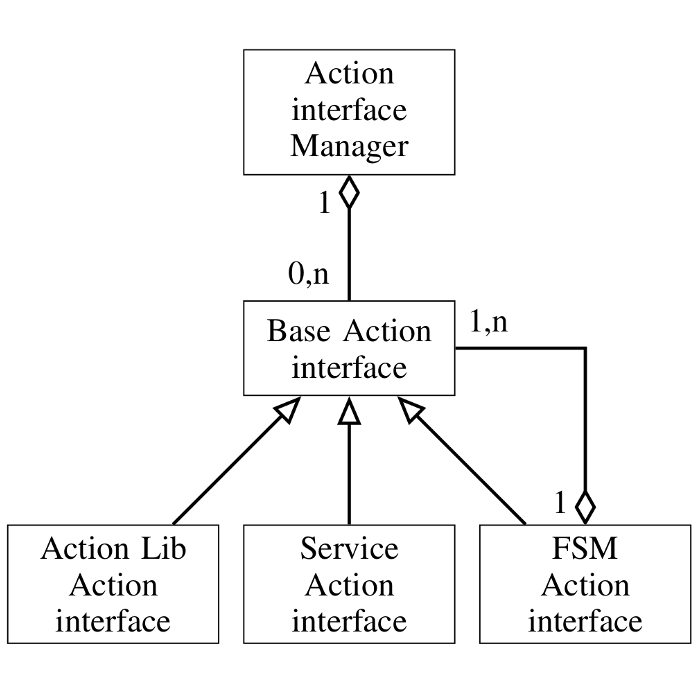
    Task planning and task execution are two high-level robot control modules that often are working with representations of the scenario at different levels of abstraction. Thus, a further mapping module is required to connect the abstract planned actions to the robot-specific algorithms that must be called in order to execute these actions.
    We present a novel implementation of such a module that allows a user to define this mapping for all actions either through either a single configuration file or user interface. This greatly reduces the amount of effort that is required to integrate an automated planner with a robotic platform. This module has been integrated as an Action Interface of the automated task planning framework ROSPlan, and includes a Graphical User Interface through which the configuration file can be easily generated and updated. The use of the interface is demonstrated in two scenarios: with robot actors possessing only a single action, and a more complex scenario with multiple agents and types of actions.
    @inproceedings{Bezrucav_planrob2021,
    author = "Stefan-Octavian Bezrucav and Gerard Canal and Michael Cashmore and Burkhard Corves",
    title = "{An Action Interface Manager for ROSPlan}",
    booktitle = "Proceedings of the 9th ICAPS Workshop on Planning and Robotics (PlanRob)",
    pages = "1--9",
    year = "2021"
    }
  • Thumbnail for publication Nemiro_wipc2021.

    Designing an Adaptable Benchmark and Competition Simulation for Integrated Planning and Execution
    Liudvikas Nemiro, Gerard Canal, Oscar Lima, Michael Cashmore, and Mark Roberts
    Proceedings of the Workshop on the International Planning Competition (WIPC), pp. 1-5, 2021

    Abstract:
    Effectively using a planning system as the executive of an agent acting in real time poses a variety of challenges in integrating planning and execution. Many integrated systems have been developed to focus on particular challenges, and it has been typically difficult to test, benchmark, and compare these systems. To do so requires a benchmark that has transparent and well-defined rules, and can be adapted to exhibit the problem characteristics of interest.
    In this paper, we propose a new benchmark simulation for integrated planning and execution, designed to be accessible and adaptive. We describe the simple, core scenario of the simulation and how it can be configured to present more challenging scenarios. We describe our plans for the development of the simulation as a competition, benchmarking, and teaching tool, and encourage the community to contribute to its design.
    @inproceedings{Nemiro_wipc2021,
    author = "Liudvikas Nemiro and Gerard Canal and Oscar Lima and Michael Cashmore and Mark Roberts",
    title = "{Designing an Adaptable Benchmark and Competition Simulation for Integrated Planning and Execution}",
    booktitle = "Proceedings of the Workshop on the International Planning Competition (WIPC)",
    pages = "1--5",
    year = "2021"
    }
There are no PhD theses in 2021.
There are no book chapters in 2021.

2020

Journal
  • Thumbnail for publication Canal_CLSR2020.

    Building Trust in Human-Machine Partnerships
    Gerard Canal, Rita Borgo, Andrew Coles, Archie Drake, Dong Huynh, Perry Keller, Senka Krivić, Paul Luff, Quratul-ain Mahesar, Luc Moreau, Simon Parsons, Menisha Patel, and Elizabeth I. Sklar
    Computer Law & Security Review: The International Journal of Technology Law and Practice, 39, 2020

    Abstract:
    Artificial intelligence (AI) is bringing radical change to our lives. Fostering trust in this technology requires the technology to be transparent, and one route to transparency is to make the decisions that are reached by AIs explainable to the humans that interact with them. This paper lays out an exploratory approach to developing explainability and trust, describing the specific technologies that we are adopting, the social and organizational context in which we are working, and some of the challenges that we are addressing.
    @article{Canal_CLSR2020,
    author = "Gerard Canal and Rita Borgo and Andrew Coles and Archie Drake and Dong Huynh and Perry Keller and Senka Krivić and Paul Luff and Quratul-ain Mahesar and Luc Moreau and Simon Parsons and Menisha Patel and Elizabeth I. Sklar",
    title = "{Building Trust in Human-Machine Partnerships}",
    journal = "Computer Law \& Security Review: The International Journal of Technology Law and Practice",
    year = "2020",
    month = "11",
    volume = "39",
    issn = "0267-3649",
    doi = "10.1016/j.clsr.2020.105489"
    }

There are no conference proceedings papers in 2020.
Conference Workshop
  • Thumbnail for publication Keren_PlanRob2020.

    Task-Aware Waypoint Sampling for Planning Robots
    Sarah Keren, Gerard Canal, and Michael Cashmore
    ICAPS Workshop on Planning and Robotics (PlanRob), 2020

    Abstract:
    To achieve a complex task, a robot often needs to navigate in a physical space to complete activities in different locations. For example, it may need to inspect several structures, making multiple observations of each structure from different perspectives. Typically, the positions from which these activities can be performed are represented as waypoints – discrete positions that are sampled from the continuous physical space. Existing approaches to waypoint selection either iteratively consider the entire space or each activity separately, which can lead to task planning problems that are more complex than is necessary or to plans of compromised quality. We offer an approach that produces more efficient plans by performing a one-time computation of the connectivity graph and by prioritizing waypoints from which multiple activities can be performed. In addition, we support user specified performance preferences that represent preferences a system operator may have about the generated task plan but that cannot be directly represented in the map used for navigation, such as areas near doorways where it is preferable that the robot does not stop to perform activities. We demonstrate the performance benefits of our approach on simulated manufacturing tasks in an automated factory.
    @inproceedings{Keren_PlanRob2020,
    author = "Sarah Keren and Gerard Canal and Michael Cashmore",
    title = "{Task-Aware Waypoint Sampling for Planning Robots}",
    booktitle = "ICAPS Workshop on Planning and Robotics (PlanRob)",
    year = "2020",
    month = "10"
    }
PhD Thesis
  • Thumbnail for publication gcanal_phdthesis.

    Adapting robot behavior to user preferences in assistive scenarios
    Gerard Canal
    PhD Thesis, Universitat Politècnica de Catalunya · BarcelonaTech (UPC), 2020
    2020 ACIA Marc Esteva Vivanco prize to the best AI PhD Thesis

    Abstract:
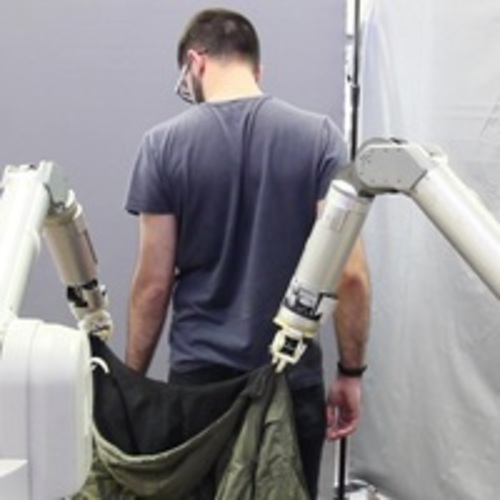
    Robotic assistants have inspired numerous books and science fiction movies. In the real world, these kinds of devices are a growing need in amongst the elderly, who will continue requiring more assistance. While life expectancy is increasing, life quality is not necessarily doing so. Thus, we may find ourselves and our loved ones being dependent and needing another person to perform the most basic tasks, which has a strong psychological impact. Accordingly, assistive robots may be the definitive tool to give more quality of life by empowering dependent people and extending their independent living.
    Assisting users to perform daily activities requires adapting to them and their needs, as they might not be able to adapt to the robot. This thesis tackles adaptation and personalization issues through user preferences. We focus on physical tasks that involve close contact, as these present interesting challenges, and are of great importance for the user. Therefore, three tasks are mainly used throughout the thesis: assistive feeding, shoe fitting, and jacket dressing. We first describe a framework for robot behavior adaptation that illustrates how robots should be personalized for and by end-users or their assistants. Using this framework, non-technical users determine how the robot should behave. Then, we define the concept of preference for assistive robotics scenarios and establish a taxonomy, which includes hierarchies and groups of preferences, grounding definitions and concepts. We then show how the preferences in the taxonomy are used with AI planning systems to adapt the robot behavior to the preferences of the user obtained from simple questions. Our algorithms allow for long-term adaptations as well as to cope with misinferred user models. We further integrate the methods with low-level motion primitives that provide a more robust adaptation and behavior while lowering the number of needed actions and demonstrations. Moreover, we perform a deeper analysis of planning and preferences with the introduction of new algorithms to provide preference suggestions in planning domains. The thesis then concludes with a user study that evaluates the use of the preferences in the three real assistive robotics scenarios. The experiments show a clear understanding of the preferences of users, who were able to assess the impact of their preferences on the behavior of the robot.
    In summary, we provide tools and algorithms to design the robotic assistants of the future. Assistants that should be able to adapt to the assisted user needs and preferences, just as human assistants do nowadays.
    @phdthesis{gcanal_phdthesis,
    author = "Gerard Canal",
    title = "{Adapting robot behavior to user preferences in assistive scenarios}",
    school = "Universitat Politècnica de Catalunya · BarcelonaTech (UPC)",
    year = "2020",
    month = "3",
    doi = "10.5821/dissertation-2117-330728"
    }
There are no book chapters in 2020.

2019

Journal
  • Thumbnail for publication Canal_AURO2019.

    Adapting robot task planning to user preferences: an assistive shoe dressing example
    Gerard Canal, Guillem Alenyà, and Carme Torras
    Autonomous Robots, 43(6): 1343-1356, 2019
    Published online in 2018

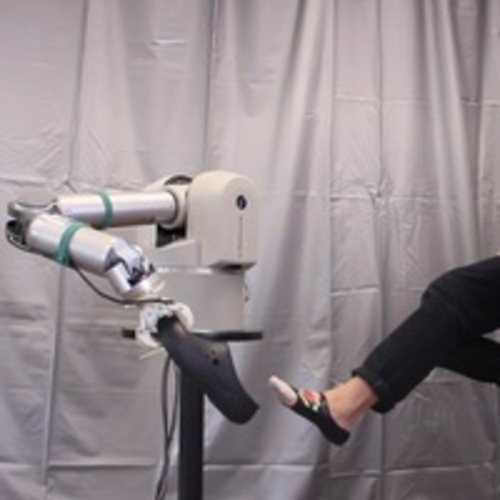
    Abstract:
    Healthcare robots will be the next big advance in humans’ domestic welfare, with robots able to assist elderly people and users with disabilities. However, each user has his/her own preferences, needs and abilities. Therefore, robotic assistants will need to adapt to them, behaving accordingly. Towards this goal, we propose a method to perform behavior adaptation to the user preferences, using symbolic task planning. A user model is built from the user’s answers to simple questions with a fuzzy inference system, and it is then integrated into the planning domain. We describe an adaptation method based on both the user satisfaction and the execution outcome, depending on which penalizations are applied to the planner’s rules. We demonstrate the application of the adaptation method in a simple shoe-fitting scenario, with experiments performed in a simulated user environment. The results show quick behavior adaptation, even when the user behavior changes, as well as robustness to wrong inference of the initial user model. Finally, some insights in a non-simulated world shoe-fitting setup are also provided.
    @article{Canal_AURO2019,
    author = "Gerard Canal and Guillem Aleny{\`a} and Carme Torras",
    title = "{Adapting robot task planning to user preferences: an assistive shoe dressing example}",
    journal = "Autonomous Robots",
    year = "2019",
    month = "8",
    day = "01",
    volume = "43",
    number = "6",
    pages = "1343--1356",
    issn = "1573-7527",
    doi = "10.1007/s10514-018-9737-2"
    }
Conference Proceedings
  • Thumbnail for publication Canal_taros2019.

    Probabilistic Planning for Robotics with ROSPlan
    Gerard Canal, Michael Cashmore, Senka Krivić, Guillem Alenyà, Daniele Magazzeni, and Carme Torras
    Towards Autonomous Robotic Systems, pp. 236-250, 2019
    2nd Place ARQ Best Paper Award and Nominated to Best Student Paper

    Abstract:
    Probabilistic planning is very useful for handling uncertainty in planning tasks to be carried out by robots. ROSPlan is a framework for task planning in the Robot Operating System (ROS), but until now it has not been possible to use probabilistic planners within the framework. This systems paper presents a standardized integration of probabilistic planners into ROSPlan that allows for reasoning with non-deterministic effects and is agnostic to the probabilistic planner used. We instantiate the framework in a system for the case of a mobile robot performing tasks indoors, where probabilistic plans are generated and executed by the PROST planner. We evaluate the effectiveness of the proposed approach in a real-world robotic scenario.
    @inproceedings{Canal_taros2019,
    author = "Gerard Canal and Michael Cashmore and Senka Krivi{\'c} and Guillem Aleny{\`a} and Daniele Magazzeni and Carme Torras",
    title = "{Probabilistic Planning for Robotics with ROSPlan}",
    booktitle = "Towards Autonomous Robotic Systems",
    year = "2019",
    publisher = "Springer International Publishing",
    pages = "236--250",
    isbn = "978-3-030-23807-0",
    doi = "10.1007/978-3-030-23807-0\_20"
    }
There are no conference workshop papers in 2019.
There are no PhD theses in 2019.
There are no book chapters in 2019.

2018

There are no journal papers in 2018.
Conference Proceedings
  • Thumbnail for publication Canal_icra2018.

    Joining high-level symbolic planning with low-level motion primitives in adaptive HRI: application to dressing assistance
    Gerard Canal, Emmanuel Pignat, Guillem Alenyà, Sylvain Calinon, and Carme Torras
    IEEE International Conference on Robotics and Automation (ICRA), pp. 3273-3278, 2018

    Abstract:
    For a safe and successful daily living assistance, far from the highly controlled environment of a factory, robots should be able to adapt to ever-changing situations. Programming such a robot is a tedious process that requires expert knowledge. An alternative is to rely on a high-level planner, but the generic symbolic representations used are not well suited to particular robot executions. Contrarily, motion primitives encode robot motions in a way that can be easily adapted to different situations. This paper presents a combined framework that exploits the advantages of both approaches. The number of required symbolic states is reduced, as motion primitives provide “smart actions” that take the current state and cope online with variations. Symbolic actions can include interactions (e.g., ask and inform) that are difficult to demonstrate. We show that the proposed framework can adapt to the user preferences (in terms of robot speed and robot verbosity), can readjust the trajectories based on the user movements, and can handle unforeseen situations. Experiments are performed in a shoe-dressing scenario. This scenario is particularly interesting because it involves a sufficient number of actions, and the human-robot interaction requires the handling of user preferences and unexpected reactions.
    @inproceedings{Canal_icra2018,
    author = "Gerard Canal and Emmanuel Pignat and Guillem Aleny{\`a} and Sylvain Calinon and Carme Torras",
    title = "{Joining high-level symbolic planning with low-level motion primitives in adaptive HRI: application to dressing assistance}",
    booktitle = "IEEE International Conference on Robotics and Automation (ICRA)",
    year = "2018",
    doi = "10.1109/ICRA.2018.8460606",
    ISSN = "2577-087X",
    pages = "3273--3278",
    month = "5"
    }
Conference Workshop
  • Thumbnail for publication Vila_irosws2018.

    Towards safety in Physically Assistive Robots: eating assistance
    Maria Vila, Gerard Canal, and Guillem Alenyà
    Robots for Assisted Living Workshop at the IEEE/RSJ International Conference on Intelligent Robots and Systems (IROS), 2018

    Abstract:
    Safety is one of the base elements to build trust in robots. This paper studies remedies to unavoidable collisions using robotics assistive feeding as an example task. Firstly, we propose an attention mechanism so the user can control the robot using gestures and thus prevent collisions. Secondly, when unwanted contacts are unavoidable we compare two safety strategies: active safety, using a force sensor to monitor maximum allowed forces; and passive safety using compliant controllers. Experimental evaluation shows that the gesture mechanism is effective to control the robot. Also, the impact forces obtained with both methods are similar and thus can be used independently. Additionally, users experimenting on purpose impacts declared that the impact was not harmful.
    @inproceedings{Vila_irosws2018,
    author = "Maria Vila and Gerard Canal and Guillem Aleny{\`a}",
    title = "{Towards safety in Physically Assistive Robots: eating assistance}",
    booktitle = "Robots for Assisted Living Workshop at the IEEE/RSJ International Conference on Intelligent Robots and Systems (IROS)",
    year = "2018",
    month = "10"
    }
There are no PhD theses in 2018.
There are no book chapters in 2018.

2017

There are no journal papers in 2017.
Conference Proceedings
  • Thumbnail for publication Canal_roman2017.

    A taxonomy of preferences for physically assistive robots
    Gerard Canal, Guillem Alenyà, and Carme Torras
    IEEE International Symposium on Robot and Human Interactive Communication (RO-MAN), pp. 292-297, 2017

    Abstract:
    Assistive devices and technologies are getting common and some commercial products are starting to be available. However, the deployment of robots able to physically interact with a person in an assistive manner is still a challenging problem. Apart from the design and control, the robot must be able to adapt to the user it is attending in order to become a useful tool for caregivers. This robot behavior adaptation comes through the definition of user preferences for the task such that the robot can act in the user’s desired way. This article presents a taxonomy of user preferences for assistive scenarios, including physical interactions, that may be used to improve robot decision-making algorithms. The taxonomy categorizes the preferences based on their semantics and possible uses. We propose the categorization in two levels of application (global and specific) as well as two types (primary and modifier). Examples of real preference classifications are presented in three assistive tasks: feeding, shoe fitting and coat dressing.
    @inproceedings{Canal_roman2017,
    author = "Gerard Canal and Guillem Aleny{\`a} and Carme Torras",
    title = "{A taxonomy of preferences for physically assistive robots}",
    booktitle = "IEEE International Symposium on Robot and Human Interactive Communication (RO-MAN)",
    year = "2017",
    doi = "10.1109/ROMAN.2017.8172316",
    pages = "292--297",
    ISSN = "1944-9437",
    month = "8"
    }
There are no conference workshop papers in 2017.
There are no PhD theses in 2017.
There are no book chapters in 2017.

2016

Journal
  • Thumbnail for publication Canal_CVIU2016.

    A real-time Human-Robot Interaction system based on gestures for assistive scenarios
    Gerard Canal, Sergio Escalera, and Cecilio Angulo
    Computer Vision and Image Understanding, 149: 65-77, 2016

    Abstract:
    Natural and intuitive human interaction with robotic systems is a key point to develop robots assisting people in an easy and effective way. In this paper, a Human Robot Interaction (HRI) system able to recognize gestures usually employed in human non-verbal communication is introduced, and an in-depth study of its usability is performed. The system deals with dynamic gestures such as waving or nodding which are recognized using a Dynamic Time Warping approach based on gesture specific features computed from depth maps. A static gesture consisting in pointing at an object is also recognized. The pointed location is then estimated in order to detect candidate objects the user may refer to. When the pointed object is unclear for the robot, a disambiguation procedure by means of either a verbal or gestural dialogue is performed. This skill would lead to the robot picking an object in behalf of the user, which could present difficulties to do it by itself. The overall system — which is composed by a NAO and Wifibot robots, a KinectTM v2 sensor and two laptops — is firstly evaluated in a structured lab setup. Then, a broad set of user tests has been completed, which allows to assess correct performance in terms of recognition rates, easiness of use and response times.
    @article{Canal_CVIU2016,
    author = "Gerard Canal and Sergio Escalera and Cecilio Angulo",
    title = "{A real-time Human-Robot Interaction system based on gestures for assistive scenarios}",
    journal = "Computer Vision and Image Understanding",
    volume = "149",
    pages = "65--77",
    year = "2016",
    doi = "10.1016/j.cviu.2016.03.004",
    note = "Special issue on Assistive Computer Vision and Robotics - "Assistive Solutions for Mobility, Communication and HMI"",
    issn = "1077-3142",
    url = "https://www.sciencedirect.com/science/article/pii/S107731421600076X"
    }
Conference Proceedings
  • Thumbnail for publication Canal_icsr2016.

    Personalization Framework for Adaptive Robotic Feeding Assistance
    Gerard Canal, Guillem Alenyà, and Carme Torras
    International Conference on Social Robotics (ICSR), pp. 22-31, 2016

    Abstract:
    The deployment of robots at home must involve robots with pre-defined skills and the capability of personalizing their behavior by non-expert users. A framework to tackle this personalization is presented and applied to an automatic feeding task. The personalization involves the caregiver providing several examples of feeding using Learning-by-Demostration, and a ProMP formalism to compute an overall trajectory and the variance along the path. Experiments show the validity of the approach in generating different feeding motions to adapt to user’s preferences, automatically extracting the relevant task parameters. The importance of the nature of the demonstrations is also assessed, and two training strategies are compared.
    @inproceedings{Canal_icsr2016,
    author = "Gerard Canal and Guillem Aleny{\`a} and Carme Torras",
    title = "{Personalization Framework for Adaptive Robotic Feeding Assistance}",
    booktitle = "International Conference on Social Robotics (ICSR)",
    year = "2016",
    doi = "10.1007/978-3-319-47437-3\_3",
    publisher = "Springer International Publishing",
    pages = "22--31",
    isbn = "978-3-319-47437-3",
    month = "11"
    }
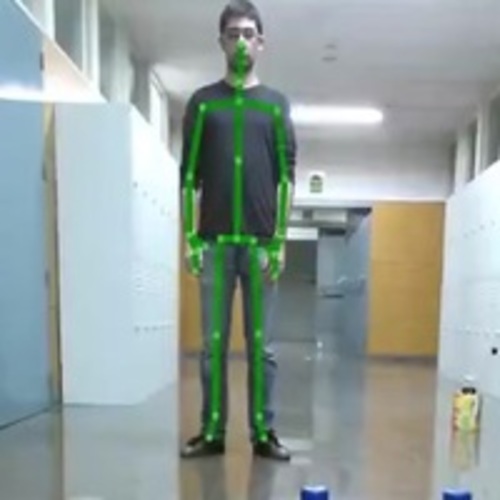
There are no conference workshop papers in 2016.
There are no PhD theses in 2016.
There are no book chapters in 2016.

2015

There are no journal papers in 2015.
Conference Proceedings
  • Thumbnail for publication Canal_ijcnn2015.

    Gesture based Human Multi-Robot Interaction
    Gerard Canal, Cecilio Angulo, and Sergio Escalera
    International Joint Conference on Neural Networks (IJCNN), pp. 1795-1802, 2015

    Abstract:
    The emergence of robot applications for non-technical users implies designing new ways of interaction between robotic platforms and users. The main goal of this work is the development of a gestural interface to interact with robots in a similar way as humans do, allowing the user to provide information of the task with non-verbal communication. The gesture recognition application has been implemented using the Microsoft’s Kinect™ v2 sensor. Hence, a real-time algorithm based on skeletal features is described to deal with both, static gestures and dynamic ones, being the latter recognized using a weighted Dynamic Time Warping method. The gesture recognition application has been implemented in a multi-robot case. A NAO humanoid robot is in charge of interacting with the users and respond to the visual signals they produce. Moreover, a wheeled Wifibot robot carries both the sensor and the NAO robot, easing navigation when necessary. A broad set of user tests have been carried out demonstrating that the system is, indeed, a natural approach to human robot interaction, with a fast response and easy to use, showing high gesture recognition rates.
    @inproceedings{Canal_ijcnn2015,
    author = "Gerard Canal and Cecilio Angulo and Sergio Escalera",
    title = "{Gesture based Human Multi-Robot Interaction}",
    booktitle = "International Joint Conference on Neural Networks (IJCNN)",
    year = "2015",
    pages = "1795--1802",
    doi = "10.1109/IJCNN.2015.7280540",
    ISSN = "2161-4393",
    month = "7"
    }


There are no conference workshop papers in 2015.
There are no PhD theses in 2015.
There are no book chapters in 2015.